Anna’s nearly ten-month housebound period
The Woman in the WindowAnna’s nearly ten-month housebound period is not absolute immobility but a life organized around the difficulty of crossing the front door. The narrative measures its duration in changing estimates, records a handful of tentative excursions, and shows how an umbrella, counting, therapy, and companionship make the boundary between indoors and outdoors negotiable without making it disappear.
Duration and Daily Life
Anna first reflects that she has not left the house in nearly a year, then qualifies the statement: in the preceding eight weeks, she has gone outside five times, each time only into the garden. The hourglass on her desk gives the passage of time a visible measure, while the sand’s slow fall sharpens the contrast between elapsed time and the smallness of her movements beyond the house.
In conversation with Jane, Anna says that she cannot go anywhere and gives the duration as ten months. Later, when Jane asks again, Anna revises the estimate to almost eleven months. The differing figures preserve the period as it is experienced and recounted: long enough to shape daily life, but not described through one fixed calendar count. During the later conversation, Jane asks what Anna does all day; Anna says that she counsels people, a description of work that contrasts with her inability to leave home.
The Garden and the Umbrella
The five outings in eight weeks are small but concrete departures from the house: Anna has managed to get as far as the garden. Dr. Julian Fielding accompanies these attempts, standing outside while she opens the door. The scene makes the threshold itself the immediate challenge; the garden is not yet a return to ordinary freedom of movement.
Anna’s means of facing that threshold is Ed’s umbrella, which Dr. Julian Fielding calls her secret weapon. Its rickety frame opens into a dark tartan canopy patterned with four black squares and four white lines. Anna studies those repeated shapes as she breathes in for a count of four and breathes out for the same count. The umbrella thus serves at once as a practical object held before her and as the focus of a measured coping ritual. Its straight-ahead projection resembles a saber or shield, giving the tentative movement outward a defensive form.
The Body and the House
Anna’s account of the period is also connected to her recovery after leaving the hospital. Almost ten months after she and Bina first met, Anna recalls that she had left the hospital with a bruised spine and a damaged throat. She and Bina exercise on a mat on the living-room floor, where Bina places a weight in the hollow of Anna’s back and Anna’s elbows wobble. The effort takes place indoors, but it shows that the housebound period includes ongoing physical work and a developing relationship with the person helping her exercise.
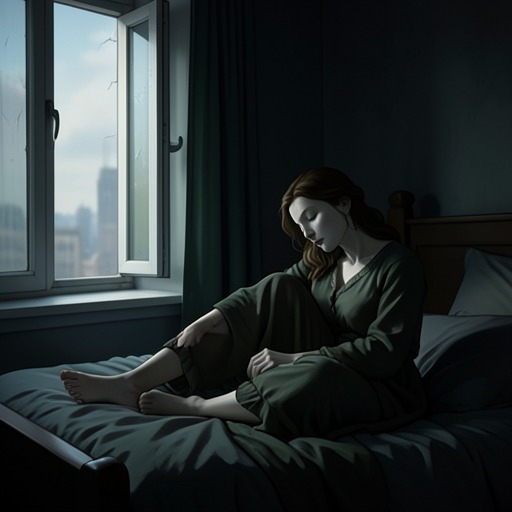
The limits of that effort appear in a brief disagreement about the room itself. Bina notes that the day is warm and suggests opening a window; Anna refuses. Even a window, unlike the door through which she has ventured into the garden, remains a boundary she is not ready to cross. The contrast makes clear that her confinement is not measured only by distance traveled: the possibility of letting the outdoors into the house also meets resistance.
Companionship and the Shape of Recovery
Dr. Julian Fielding’s presence in the garden turns each outing into a supported attempt, while Bina’s nearly ten months of visits and exercise have grown into fondness and perhaps friendship. These connections do not erase Anna’s restrictions, but they give the period a social dimension: one person stands with her at the door, and another works with her inside the living room.
The period’s progress remains incremental rather than triumphant. Five garden excursions in eight weeks coexist with Anna’s continued inability to go elsewhere, and the umbrella’s precise pattern and four-count breathing make each attempt deliberate. The house is both the place where she can exercise and counsel others and the space whose door and window remain difficult to open. That tension defines the period: movement is possible, but it is narrow, rehearsed, and dependent on supports that make the next step imaginable.